About Carbonation 

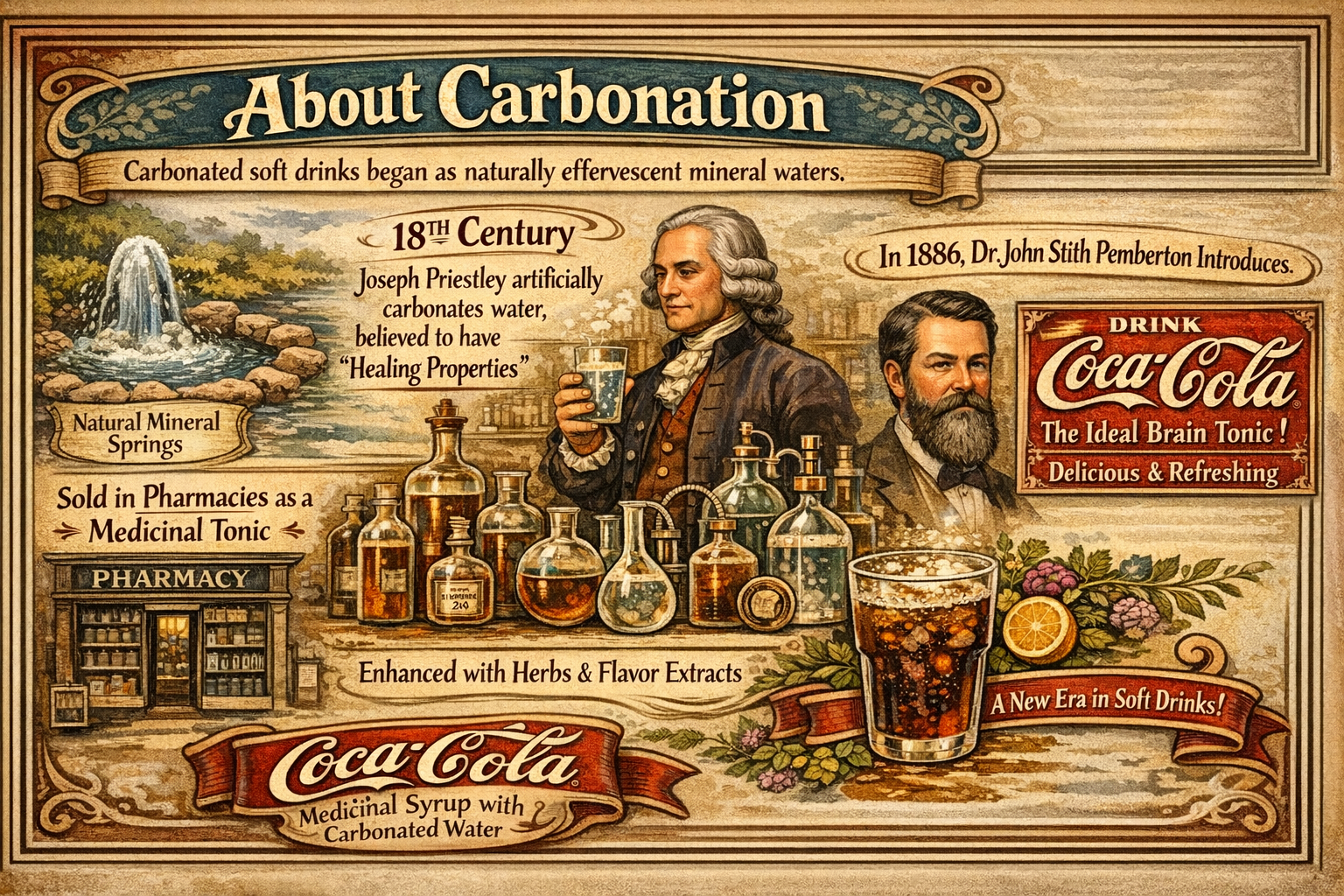
Carbonated soft drinks began as naturally effervescent mineral waters

In the 18th century, beliveing it had healing properties, scientists like Joseph Priestley learned to artificially carbonate water, and pharmacies began selling it as a medicinal tonic for digestion and throat ailments. Pharmacists enhanced these drinks with herbs, botanicals, and flavor extracts, gradually transforming them from remedies into enjoyable refreshments. In 1886, John Stith Pemberton introduced Coca-Cola as a medicinal syrup mixed with carbonated water, marking a pivotal shift toward commercial soft drinks. Carbonation evolved from pharmacy-based medicine to a global beverage industry centered on refreshment

Carbonation in beverages is measured in volumes of C02, which refers to the number of liters of gas dissolved in one liter of liquid. Most sodas fall between 3.0 and 4.0 volumes, while energy drinks and fruit-flavored sodas tend to have lower levels. 


The "Super Fizz" Category | 4.5 – 6.0+ Volumes

These have the most aggressive bubbles, often requiring special reinforced glass to prevent the bottles from exploding.

    • Champagne (e.g., Moët & Chandon, Veuve Clicquot): 4.6 – 6.0 volumes

    • German Wheat Beers (e.g., Erdinger, Paulaner): ~5.0 volumes

    • Mumm Champagne: Up to 6.35 volumes

    • SodaStream (Highest Setting): Can reach up to 5.0 volumes 

High Carbonation: Standard Sodas & Mixers | 3.5 – 4.0 Volumes 

This is the "sweet spot" for most major global soft drinks.

    • Sprite: 3.8 volumes

    • Coca-Cola / Pepsi: 3.5 – 3.8 volumes

    • 7UP: 3.7 volumes

    • A&W / Barq’s Root Beer: 3.5 – 4.0 volumes

    • Perrier (Bottled): 3.53 volumes

    • Canada Dry / Schweppes (Ginger Ale/Tonic): 3.2 – 3.5 volumes

    • Dr Pepper: 3.4 – 3.6 volumes

    • Club Soda: 3.0 – 3.5 volumes 

Medium Carbonation: Sparkling Waters & Energy Drinks | 2.5 – 3.2 Volumes

These have a noticeable "zip" but are less sharp than a standard cola. 

    • Mountain Dew: 3.2 volumes

    • Red Bull / Monster Energy: ~2.7 – 3.0 volumes

    • LaCroix / Topo Chico (Canned): 2.8 volumes

    • Spindrift: 2.8 volumes

    • S.Pellegrino: 2.68 volumes

    • Liquid Death (Sparkling): 2.55 volumes

    • Budweiser / Standard Lagers: 2.4 – 2.7 volumes 

Low Carbonation: Fruit Sodas & Ales | 1.5 – 2.2 Volumes

These drinks are often described as "refreshing" or "soft" rather than "fizzy." 

    • Guinness (Draught): 2.2 volumes

    • Fanta (Orange/Fruit flavors): 1.8 volumes

    • British Cask Ales: 1.5 – 2.2 volumes

    • Cava (Brut Nature): ~1.53 volumes 

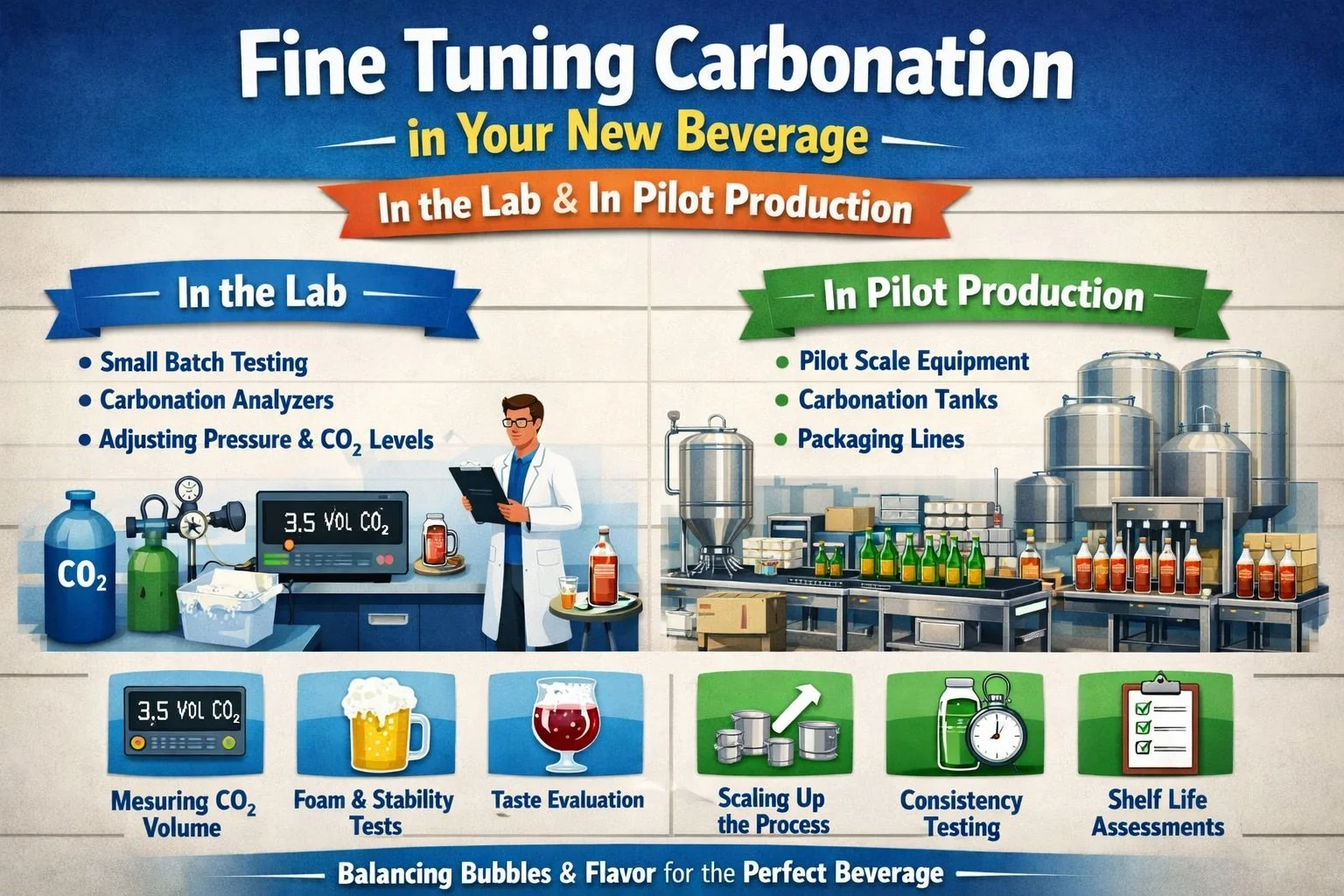
Lab-made carbonated samples often won’t feel the same as drinks from a production line Lab carbonation is less controlled & changes quickly with handling especially temperature change

One way to get an accurate taste test is to bring ice-cold “reference” drinks that match the carbonation level you like, keep them in a cooler the entire time, and have the lab team keep both the references and new prototypes ice-cold before, during, and after carbonation and tasting. This lets the team compare side-by-side and adjust carbonation to match as closely as possible.

  • Why Lab Carbonation Rarely Matches Production & How to Get Better Tasting Results

    When you taste a carbonated drink that “just came out of the lab,” it’s easy to assume the carbonation level should feel as consistent as a product off a commercial line. In reality, lab-made carbonation is often less controlled, less repeatable, and more sensitive to handling than mass production carbonation.

    That doesn’t mean lab samples are useless—far from it. It just means you need the right expectations and the right sampling practices so you can evaluate flavor accurately.

    Below is a practical guide you can share with anyone tasting carbonated prototypes (and with lab teams making them).

    Lab carbonation isn’t the same as production carbonation

    In mass production, carbonation is typically dialed in using equipment designed for precision and repeatability, such as:

    • Controlled chilling systems that keep the beverage at a tight temperature range

    • Inline carbonation systems with stable pressure/flow

    • Tank carbonation with regulated pressure and contact time

    • Consistent packaging/filling systems (counter-pressure filling, controlled headspace, minimal foaming)

    • Quality checks and feedback loops to keep CO₂ levels steady run after run

    A lab environment, by contrast, often involves small batches and tools/processes that are inherently more variable:

    • Manual carbonation methods (pressurized vessels, carbonation caps, small carbonation stones, shaker systems)

    • Small containers and inconsistent headspace from sample to sample

    • Short equilibration times (carbonation needs time to dissolve evenly)

    • More handling (moving samples, opening/closing, pouring multiple times)

    • Temperature swings as samples sit out during tasting

    So even if the lab team “hits the same pressure,” the perceived carbonation can still differ due to temperature, package, headspace, and how the sample is handled.

    The biggest reason carbonation is “off” in the lab: temperature

    Carbonation stability is extremely temperature-sensitive.

    Cold liquid holds dissolved CO₂ better than warm liquid.
    As drinks warm up, CO₂ becomes less soluble and escapes faster—especially once the container is opened, poured, or agitated.

    That’s why a sample that tastes perfect right after carbonation can taste flat (or inconsistent) a short time later if it’s been sitting out—even if nothing “went wrong” with the recipe.

    Why this matters for tasting

    Carbonation doesn’t just add bubbles. It changes how the drink tastes:

    • It adds bite/tingle (trigeminal sensation)

    • It can increase perceived acidity (carbonic acid)

    • It can suppress or shift sweetness perception

    • It affects aroma release and how flavors “lift” off the palate

    • It changes mouthfeel and the “finish” of the drink

    So if carbonation is significantly higher or lower than intended, you may not be tasting the formula accurately.

    Best practice in a lab scenario: bring “reference” drinks and keep everything ice-cold

    If you want the lab team to match the carbonation you like, the single most effective step is this:

    Bring sample drinks that have the carbonation you want

    Bring commercial products (or prior internal samples) that represent the carbonation level and mouthfeel you’re aiming for.

    These are your reference standards.

    When your new prototypes come out of the lab, give the reference samples to the lab team so they can:

    • Taste side-by-side

    • Use them as a sensory target

    • (Ideally) measure and match carbonation as closely as possible

    The rule: references must be ice-cold and stay that way

    To make this work, your references must be kept ice-cold from start to finish:

    Before you arrive

    • Store the reference drinks in a refrigerator (not just “cool,” but truly cold)

    • Transport them in a cooler packed with ice or cold packs

    • Do not leave them in a warm car, even briefly

    When you arrive

    • Ensure they are still ice-cold

    • Keep them in the cooler until the moment they’re needed

    • Make sure the lab staff agrees to store them cold (fridge or ice bath)

    During experimentation and tasting

    • The lab team should also keep all test samples ice-cold:

      • before carbonation

      • during carbonation

      • during any waiting/equilibration time

      • during tasting

      • after tasting (if samples will be re-checked)

    If your references get warm, or if the prototypes warm up during sampling, your comparison becomes unreliable.

    How to run a cleaner carbonation tasting in the lab

    Here are practical steps that dramatically improve accuracy:

    1) Standardize tasting temperature

    Pick a tasting temperature (commonly “ice-cold”) and stick to it for:

    • reference drinks

    • prototypes

    • glassware (even warm glass can accelerate CO₂ loss)

    Use an ice bath on the bench if needed.

    2) Minimize time open to air

    Carbonated samples change fast once opened. For side-by-side comparisons:

    • Open reference and prototype close together in time

    • Pour immediately

    • Taste promptly (don’t let one sit while another is discussed)

    3) Pour gently and consistently

    Foam and aggressive pouring drive CO₂ out.

    • Use the same pour height, angle, and speed each time

    • Avoid stirring or swirling carbonated samples

    4) Allow carbonation to equilibrate

    If a drink is carbonated and tasted immediately, the CO₂ may not be evenly dissolved yet.

    • Give newly carbonated samples time to stabilize while cold

    • Use the same wait time each round so comparisons are fair

    5) Keep packaging and fill levels consistent

    CO₂ behavior changes with:

    • bottle vs can vs lab bottle

    • different bottle sizes

    • different headspace volumes (how full the container is)

    Whenever possible, standardize:

    • container type

    • fill volume

    • closure method

    6) Document the “carbonation target”

    Even if the lab can’t perfectly replicate production, you can still get much closer by documenting:

    • target sensory outcome (“crisp, high sparkle” vs “soft, lightly sparkling”)

    • reference product name

    • sample temperature during carbonation and tasting

    • pressure/time settings used

    • any observations about foaming or instability

    This makes future rounds far more consistent.

    The best place to truly dial in carbonation: pilot production

    If the goal is to match what consumers will experience, the best practice is:

    Go to the facility for pilot production and dial in carbonation there

    A pilot line (or production-like setup) is where carbonation decisions become meaningful because it replicates:

    • production chiller performance

    • real carbonation equipment and controls

    • real filler behavior (counter-pressure, foam control)

    • real package formats and headspace

    • line speeds and handling conditions

    In other words: pilot production is where carbonation becomes real.

    Lab carbonation should still aim to get close—because you need accurate flavor feedback early—but the final “lock” is best done in pilot.

    What to tell the lab team (a simple script)

    Here’s a straightforward way to communicate expectations and process:

    • “Lab carbonation won’t be as controlled as production, so we’re bringing reference drinks that represent the carbonation we want.”

    • “These reference samples must stay ice-cold in coolers and remain ice-cold in the lab at all times.”

    • “Please keep all prototypes ice-cold before, during, and after carbonation and during tasting.”

    • “When the prototypes are ready, we’ll taste side-by-side with the reference and adjust carbonation to match as closely as possible.”

    • “If anything warms up, the tasting won’t be accurate, so temperature control is non-negotiable.”

    Quick checklist for reliable lab carbonation tasting

    • ✅ Bring reference drinks with your desired carbonation

    • ✅ Keep references ice-cold in a cooler during transport

    • ✅ Ensure lab staff stores references cold immediately upon arrival

    • ✅ Keep prototypes ice-cold before/during/after carbonation

    • ✅ Standardize tasting temperature, timing, and pour method

    • ✅ Taste reference and prototype side-by-side quickly

    • ✅ Dial in final carbonation at pilot production whenever possible

    If you want, I can also rewrite this as:

    • a one-page SOP you can send to labs (with a checklist format), or

    • a short email/template for customers or stakeholders explaining why lab samples can taste “off” and how you’ll control it.Description text goes here