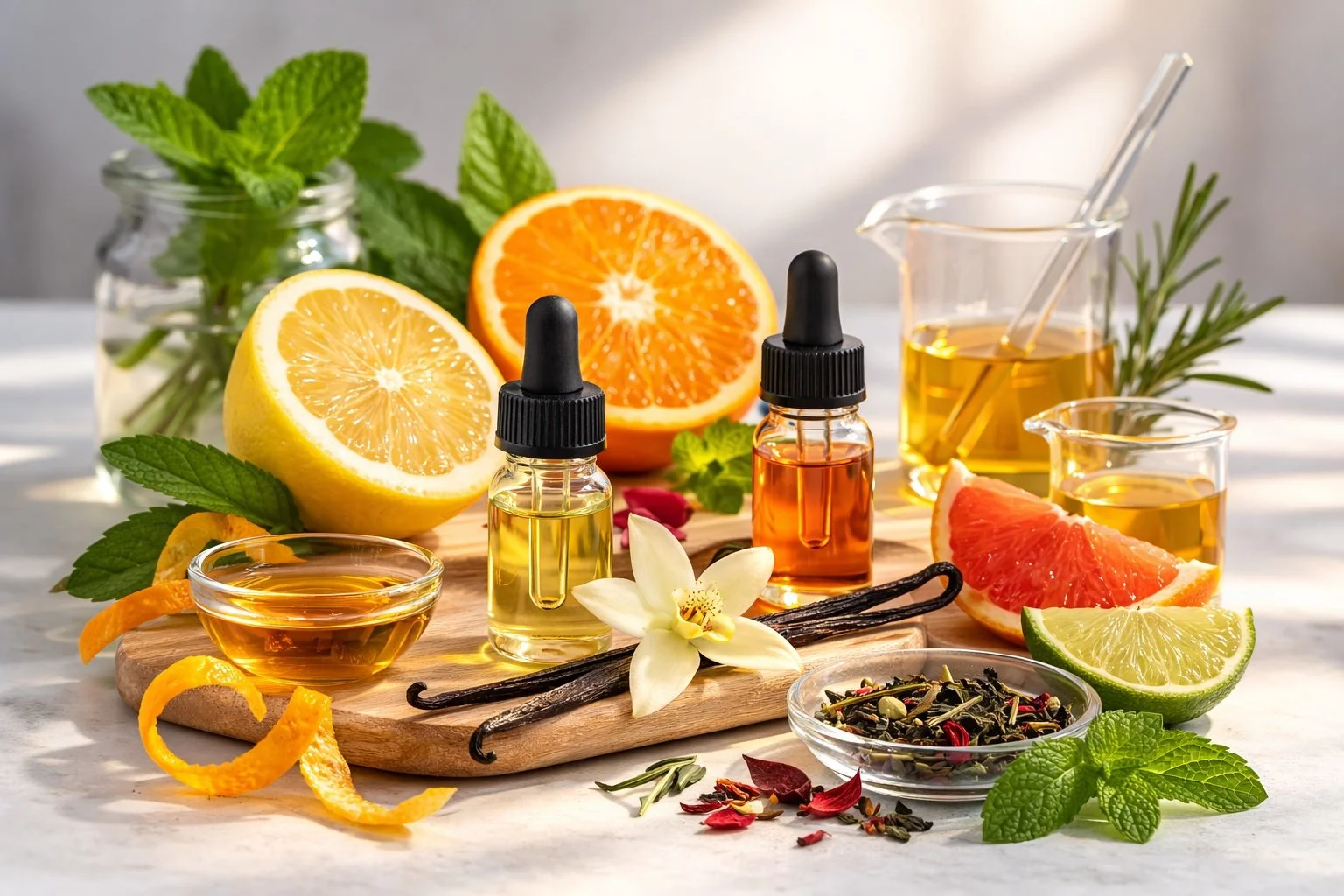
“natural flavor” is a technical labeling category, not the same thing as squeezing fruit or steeping botanicals directly into a drink.
It means the flavor components were originally derived from natural sources and then processed into concentrated systems that deliver reliable, scalable taste.
These ingredients are widely used and considered safe, but they are fundamentally different from building flavor entirely from whole, recognizable ingredients.
For founders, the key is not whether natural flavors are allowed - it’s understanding how they’re made, what they do, and whether they align with your product philosophy and brand story.
-
When you see “natural flavor” on a label, it doesn’t mean fruit squeezed into the drink.
It means the parts of a fruit, herb, or spice that create aroma and taste were separated, concentrated, and standardized so they can be used reliably in food production.
Here’s what that really looks like.
It Starts With Real Plants
Natural flavors must begin with something that qualifies as natural under food regulations — fruit, herbs, spices, roots, bark, leaves, fermentation products, and so on.
But whole fruit isn’t what ends up in the flavor drum.
A strawberry, for example, is mostly water. It also contains sugar, fiber, acids, pigments, seeds — and tiny amounts of aromatic molecules that create the smell and taste we recognize as “strawberry.”
Those aromatic molecules are what the flavor industry is after.
Separating the Flavor From Everything Else
To get those aroma compounds, the plant material is processed so the flavor molecules can be pulled out and isolated.
This can happen through:
Steam extraction – heat releases volatile aroma compounds.
Alcohol extraction – alcohol dissolves flavor molecules out of the plant material.
Other food-grade solvents – liquids that dissolve specific compounds.
Enzymes – natural proteins that break apart plant structures to release trapped flavor components.
A solvent, in simple terms, is just a liquid that dissolves something else. Water is a solvent. Alcohol is a solvent. In food processing, only approved food-grade solvents are used, and they’re removed or reduced to safe levels.
After this step, what’s left is no longer fruit. It’s a concentrated mixture of the molecules responsible for smell and taste.
The fiber is gone.
Most of the sugars are gone.
The bulk of the plant material is gone.What remains is flavor chemistry.
Making It Consistent
Here’s the part most people don’t think about:
Fruit changes. Seasons change. Crops change.
If you extracted strawberries from two different farms, the flavor would not be identical.
But consumers expect consistency. A strawberry beverage should taste the same every time.
So flavor companies adjust and blend extracts to create a consistent profile. They may:
Combine extracts from different sources
Remove harsh or “green” notes
Reinforce certain aroma notes
Balance sweetness perception
The goal isn’t to recreate one specific strawberry.
It’s to recreate the idea of strawberry — consistently.At this stage, the flavor is no longer just an extract. It’s a designed system.
Turning It Into Something Usable
Concentrated flavor compounds are extremely potent. Some evaporate easily. Some degrade in heat. Some are oil-based and don’t mix well with water.
So they’re diluted into a carrier like:
Alcohol
Water
Glycerin
Propylene glycol
This makes the flavor:
Stable
Measurable
Easy to blend into beverages
In concentrated form, some of these blends can be flammable — just like many alcohol-based extracts. But in finished beverages, they’re used at very small percentages.
What Ends Up in the Beverage Plant?
Usually, it’s a pail or drum of liquid.
Inside that liquid are:
Aroma compounds originally derived from natural materials
Blended and standardized for consistency
Diluted into a carrier
It doesn’t look like fruit.
It doesn’t contain pulp.
It doesn’t provide nutrition.But the flavor compounds came from natural sources, which is why it qualifies as “natural flavor” under regulations.
So… How Natural Is It?
Natural flavors are:
Natural in origin
Processed and refined in execution
Designed for performance
They are not whole fruit.
They are not minimally processed.
They are not the same as steeping tea or squeezing citrus.They sit somewhere in between.
Natural source → industrial refinement → consistent flavor system.
That’s the most accurate way to think about it.
Why the Industry Uses Them
Because whole ingredients:
Vary from season to season
Are expensive at high usage levels
Can shorten shelf life
Change flavor over time
Natural flavor systems solve those problems. They allow companies to use tiny amounts, maintain consistency, control cost, and deliver the same experience every time.
The Clear Takeaway
Natural flavors start with real plants.
They’re processed to isolate and concentrate the molecules that create taste and aroma.
They’re blended and standardized to behave consistently in beverages.
They are natural in origin — but engineered in practice.
Once you understand that, you can decide what your beverage should rely on:
Whole ingredients
Flavor systems
Or a thoughtful mix of both
That’s the real conversation.
Here are alternative ways to flavor beverages.
-
In beverages, “artificial flavor” refers to flavor compounds that are synthesized rather than derived from qualifying natural sources. They are designed to replicate specific taste and aroma profiles with high precision, stability, and cost efficiency. Artificial flavors are regulated for safety just like other food ingredients, and in many cases they are chemically identical to compounds found in nature. The key distinction is origin, not necessarily structure. For founders, artificial flavors are a practical tool—often more affordable and consistent—but they may not align with a brand positioned around natural or whole-ingredient storytelling.
-
Fruit juice is one of the most straightforward ways to flavor a beverage because it contributes both taste and sweetness directly from recognizable ingredients. Whether used as not-from-concentrate or from concentrate, juice brings acidity, aroma, color, and natural sugars in a single component. Unlike isolated flavor systems, juice remains closer to its whole-food origin, though it still undergoes processing for safety and stability. For founders, juice offers label transparency and consumer familiarity, but it also adds sugar load, cost, and formulation complexity that must be managed intentionally.
-
Using whole fruits or vegetables—whether puréed, pressed, or blended—allows a beverage’s flavor profile to come directly from the ingredient itself. Carrot, beet, cucumber, watermelon, mango, and berry bases can define a drink without relying on added flavor systems. These ingredients contribute natural sweetness, texture, color, and aroma in an integrated way. The tradeoff is variability, shelf-life management, and higher ingredient usage rates. For brands seeking a fully ingredient-driven profile, fruits and vegetables offer authenticity and simplicity, but they require careful formulation and processing discipline.
-
Steeping botanicals—such as hibiscus, chamomile, mint, ginger, or spices—creates flavor the traditional way: extraction into water. This method produces complexity and depth directly from the plant material, without the need for added flavor blends. Tea with sugar is a simple example: the tea leaf provides flavor, the sugar provides sweetness, and the beverage remains entirely ingredient-driven. Hibiscus with lemon juice and fruit juice for sweetness is another fully natural system. These approaches emphasize simplicity and transparency, though they demand precision in extraction, stability, and balance.
-
Flavor can also develop through fermentation, distillation, roasting, or simple blending of whole ingredients. Kombucha gains its character from fermentation. Cold brew coffee derives its profile from time and extraction method. Sparkling water with citrus juice relies on carbonation and acidity to elevate subtle flavors. In each case, the flavor is built from identifiable inputs rather than isolated flavor systems. For founders, the principle is simple: every ingredient affects flavor. Water quality, sweetness system, acid balance, and carbonation often matter as much as the flavor source itself.